Tuesday, February 25, 2014

Are We Finally Reaching A Top In Natural Gas?

Natural gas tumbled more than 11% in Monday trade, with the front month March contract finishing at $5.445 / mmbtu - its biggest one day fall in more than six years.

This is poised to be an interesting week for natural gas - especially for the March contract - as it expires on Wednesday.

The latest NOAA 8 to 14 day outlook is still pointing to large areas of the central and eastern U.S to have below average temperatures, however the forecast is beginning to look a lot more mild.


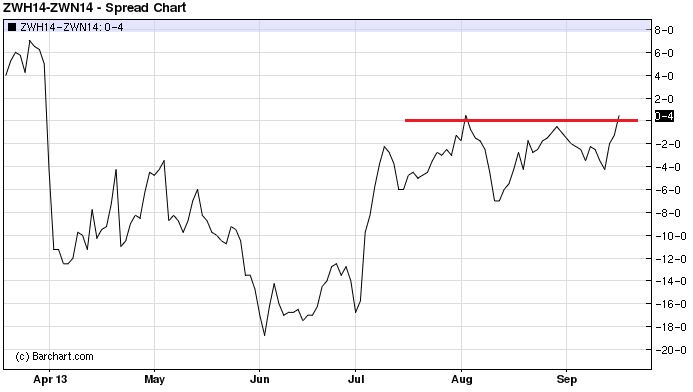
As it stands I'm currently short the Jul14/Sep14 spread and continuing to hold, looking for a move lower.

My thinking here is that we've basically seen all natural gas spreads get pushed out well above what we might expect historically for this time of year.

That said, supplies are at a record deficit of 34 percent to the five-year average so it's certainly not unjustified.

However markets by their very nature do tend to overshoot the mark as they seek out a fair price. The main problem being the fact that we have the potential to get stopped out in the process and miss the entire move.

As a result I think the best course of action for those looking for some exposure to the potential drift lower is to take a trade in the less volatile shoulder months (May–June and September–October), to hopefully avoid any potential carnage and give us the best risk/reward we can.

I would certainly avoid the front months at the very least.

Tuesday, October 8, 2013

Strength In Soymeal

I don't usually focus on outrights but soymeal has come up on my radar.

Soymeal values worldwide are being boosted by poor availability in Argentina, the top exporter, where farmers are hanging on to soybeans, as a hedge against buoyant inflation and a falling peso.

My personal indicators are showing solid strength and as a bonus we also have a seasonal window.

I don't put as much weight in the outrights in terms of their seasonality but it's nice to have.

I'm very interested to see how this one trades on Tuesday. For now it's one to watch.

Wednesday, October 2, 2013

Potential Cyclone Hurting NG Spreads

The National Hurricane Center is showing a weather system in the northwestern Caribbean Sea that stands a 50% chance of developing into a tropical cyclone in the next five days as it heads into the southern Gulf of Mexico near the Yucatan Peninsula and eastern Cuba.

NG spreads got hit badly in Tuesday (and Monday for that matter) trading and I think we have to cover out shorts here.

The Nov13/Jan14 bear spread was essentially a play on the late heat wave heading into the shoulder season and this has fundamentally changed things.

Monday, September 30, 2013

Quick Grain Stocks Preview

A quick look at the numbers ahead of quartelry grains stocks.

I'm keenly watching wheat and wondering if potential bullish news is already priced in. Time will tell.

I also just read this on Agrimoney:

While analysts have underestimated corn and soybean stocks in four of the last six years, in wheat, they have a greater tendency to put their inventory guess in too high.

Friday, September 27, 2013

Natural Gas Continues To Look Weak

Thursday's natural gas storage number only helped to send an already weak spread, even lower.

Storage came in at 87 BCF vs the market consensus of 76 BCF. The October contract was a bit all over the place as it was going off the board, however our spread continued its path to a lower close .

Looking at the weather situation, the NOAA 8-14 day forecast is looking a lot less supportive than what it was only a week or two earlier.

There also doesn't appear to be much in way of storm activity threatening natural gas operations in the Gulf.

So for now I'm happy to continue to hold my short (Nov13/Jan14 bear spread) position as we continue to move into the shoulder season.

Thursday, September 26, 2013

Is The PEDv Virus Behind The Rally In Hogs?

Lean hogs hit a record high in Wednesday trade and are up 6% over the past month, with traders keeping a close eye on slaughter rates and the size of the herd.

Concerns are mounting that the USDA's hogs and pigs report will show an unseasonal drop in slaughter rate, thought to be down to the PEDv diahorrea virus.

The opinion of analysts on whether the herd has grown or shrunk is mixed with the range of estimates ranging from a contraction of 3.6% to expansion of 0.3%.

I'm still in my bear spread but have a tight stop and will keeping a very close eye on the action over the next couple of days.

The USDA's quarterly hogs and pigs report is due out at 2 p.m. CDT.

Friday, September 20, 2013

Will Cattle Numbers Continue To Tighten?

Cattle prices jumped Thursday ahead of the Cattle on Feed data which is expected to show tightening supplies of beef.

With feeder margins now around negative $29 and an apparent declining feedlot herd, I'll be interested to see if the trend of lower placements continues with Fridays data.

From Cattlenetwork:
Friday’s USDA cattle report is expected to show fewer Cattle on Feed compared to the previous year and placements at their lowest level since the USDA started tracking data in 1996.

August placements are expected to fall from the previous year with numbers forecasted to be 8.9 percent lower than Sept. 1, 2012 data according to Allendale, Inc.
  Some analysts were anticipating higher placements in the August report. Last month’s placements in feedlots during the month of July totaled 1.72 million. The July total was a 10 percent decrease from the same time a year earlier.

The decline is expected to continue as Allendale says cattle feeders remain wary of placing new cattle given the continued loss situation on outgoing cattle. Feeder margins are still in the red, however they have improved over the past month averaging negative $29 per head.

Cattle on feed projections are also lower, with Allendale expecting Friday’s report to show a 6.6 percent decline compared to a year earlier. Last month’s report showed 10 million cattle and calves on feed for slaughter market on August 1, moving six percent lower than the same time period in 2012. The decrease in last month’s data set a new five-year low.

The lower figures reveal decreased beef production numbers lie ahead, which could be impacted further if cow-calf producers decide to retain animals to expand their herds.

The USDA Cattle on Feed report will be released Friday at 7:30 a.m. CST.

Wednesday, September 18, 2013

A Parity Trade In Wheat

Wheat has been a bit of a follower of recent times as much of the action has been in corn and soybeans.

Even in the last WASDE report, wheat came in much in-line with expectations.

There was some talk around of reasonably strong demand going forward and as recently as yesterday, Abares, the Australian commodities bureau, stoked concern of a shortage of 'quality' wheat.

This time of year this wheat spread (Mar14/Jul14) benefits from the March contract coming under pressure when other worldwide markets (such as Australia) begin their harvest toward the end of the year.

Traditionally the best time to enter this one isn't until October 24th, however I love it when a spread trades at parity as if offers both a good technical and historical reason to enter.

I'm short this one from parity.

Monday, September 16, 2013

AUD Strong At The Close In Sydney On Summers

The Aussie dollar has been strong in trade on Monday with news over the weekend that Larry Summers has withdrawn from the race to succeed Ben Bernanke at the Fed.

With Summers gone it leaves Professor Janet Yellen as the front-runner for the top job.

Summers was widely expected to be in favour of tapering QE and certainly more so than Yellen.

With Summers gone it leaves the door open for a longer period of low rates in the US and more strength (for now at least) in the AUD.

Friday, September 13, 2013

A Quick WASDE Review

Taking a quick look at the numbers from the USDA I think the interesting things to note are the corn yield and soybean ending stocks.

Corn sold off a touch as we saw a reasonably strong yield number.

Conversly with tighter than expected ending stocks for soybeans, they had a definite bid in them post report and closed strongly.

For wheat there appears to be plenty of supply around, however demand is also quite strong at the moment.

Thursday, September 12, 2013

What Will The WASDE Report Mean For Cotton?

Taking a quick look at cotton ahead of the WASDE report later today, the USDA is expected to lift the forecast for world production by some 400,000 bales to 117m bales, largely reflecting improvements in India.

Weather conditions have been favorable in India potentially leading to a bumper crop.

The USDA is also expected to raise its projections for output in the United States, the world's top exporter.

While this will be bearish for cotton, bulls will certainly be watching import demand figures for China, the world's leading cotton buyer, where expectations have been raised since last month.

I'm currently short cotton.

USDA Preview

Traders are once again poised for the release of this months WASDE report, with much of the focus on just how much the recent heat has damaged yields.

For me the main point of interest is in soybeans, specifically the reduction in yield.

There are a couple of things to look at. I've personally noted that the USDA has most recently had a tendency to make only small adjustments to yields and ending stocks compared to the market consensus and specifically some of the independent grain analysts.

Something that was also worthy of note in last months report was just how the USDA came up with their figure.

Taking a look at soybeans for instance, the potential for the yield estimate to actually reflect crop damage, being drawn largely from data taken late last month, and using a five-year average for the pod weight, tends to make me think that we might be in-line for a more bearish number.

And as for corn (and some extent soybeans) the actually anecdotal evidence we keep hearing from farmers is that yields are looking quite solid. Another point to the bear camp.

Overall I'm looking for a somewhat bearish report, however I currently have no positions in corn, soybeans or wheat.


AUD Continues To Drift Lower On Weak Jobs

We continue to see weakness in the AUD at the close in Sydney, after a poor jobs number rattled the markets earlier in the day.

The number of people employed fell 10,800 in August, compared with estimates for a 10,000 increase.

Unemployment rose to a four-year high of 5.8 percent, from 5.7 percent in July.

Traders are pricing in a 40 percent chance the RBA will cut rates by the end of this year, compared with 38 percent before the release.

Coffee Finally Gets A Boost On Brazilian Support

Coffee jumped the most in eight months after an announcement by Brazilian authorities of R$1bn in support for the coffee industry, including R$284m for funding storage of crop and R$242.6m in working capital for producers.

There was also some concern about dry weather in Brazil causing damage to trees that have already flowered.

However there is still certainly a bearish undertone to the coffee market with a strong Brazilian harvest and a larger one expected next year, as well as a decent Vietnamese robusta crop on the horizon.

Wednesday, September 11, 2013

Turning From Syria To The Supply Side For Crude

After President Obama spoke Tuesday evening, it now looks increasingly likely that a Russian diplomatic option will be the more probable outcome for Syria.

With that in mind we've seen the oil complex sell-off over the last few sessions and attention will now move to supply side issues.

Interestingly they too seem to be adding to the bullish tone in oil that we've been seeing for the last couple of months.

On Tuesday, OPEC cut its August oil output to 29.93 million barrels a day, the lowest level in two years, according to a monthly report from the.EIA.

Prior to the Syrian crisis, there was a sharp reduction in oil output from Libya amid strikes at the country's oil-export terminals.

Another OPEC report Tuesday showed that Saudi Arabia and Iraq have made up for some of the losses in Libyan production,adding to supply.

I've been looking to potentially short some spreads in crude and heating oil as they've been trading at levels that I would consider too wide by historical standards, however with the bullish undertone I'm hesitant at the moment.

Wait and see for now.

Tuesday, September 10, 2013

Weather Still Driving Hogs And Natural Gas But For How Long?

Front month lean hogs futures closed basically unchanged in Monday trade, however there was definate strength in the Dec contract.

Warmer weather across much of the US has put pressure on hog weights and as a result has hurt supplies.

The latest 8-14 outlook from the NOAA shows the bulk of the US still expecting above average temperatues.

Weather was also the key driver for natural gas with front month closing around the $3.6/mmbtu mark.

There has also been some action in the tropics again but it's not hugely concerning to the US at the moment.

Whilst we do have some heat around, I'm still not expecting it to be quite as severe given that it's late in the season.

Monday, September 9, 2013

A Good Trade In Wheat?

Today I wanted to highlight another spot that I'll be watching over the next few weeks.

Wheat has been a bit of a follower in the grain markets of recent times as all the action has been in corn and soybeans on the back of hot weather and tight old crop supplies.

Wheat has been chopping around for a month or so, as there have been some issues with the competitiveness of US wheat in comparison to other worldwide markets.

The thing that intrigues me here is that the Mar14/Jul14 spread is trading around parity. For me parity is always a nice entry point and acts very much as a support/resistance level in many instances.

This spread benefits from the March contract coming under pressure when other worldwide markets (such as Australia) begin their harvest toward the end of the year.

Traditionally the best time to enter this one isn't until October 24th, but like I mentioned parity could be offering us a good price, both technically and historically.

We've seen this one bounce off parity twice already and it might be worth having a look should it trade in that vicinity again.

Friday, September 6, 2013

Is The Bearish Storage Number The Signal To Short Natural Gas?

On Thursday we saw an injection into storage of 58 BCF (exp 54 BCF), which sent natural gas prices lower.

Natural gas has been on a bit of an uptrend over the last month on the back of an extended hot streak.

While the weather is above average for this time of year, as it's not the peak of summer, we probably shouldn't expect power demand to be quite as high.

I've been watching with an eye to getting short the Nov13/Jan14 spread as the shoulder months, periods of lower demand, are approaching.

This week we also saw some storm activity on the horizon which had traders thinking about the possibility of weather factors in the near future. This added to the bullish tone early, but nothing really eventuated of any relevance to the US.

All these things have seen the Nov13/Jan14 spread trade at levels well off what we would expect for this time of year. Traditionally this one hasn't really traded above 20 in the last 10 years or so.

Seasonally the window opens on the 18th of September but I like these levels so I'll jump in a touch sooner. If you're patient you can probably even work a better price as we often get a pullback on the back of a sharp reversal.

Thursday, September 5, 2013

Is It Time To Short Coffee?

I've had my eye on a couple of coffee spreads over the last few weeks looking for a slight pullback.

In that time we've seen continued weakness in the real, a Brazilian rate rise, Central Bank intervention and frost fears.

However none of those factors have been able to get coffee (or the spreads) to really bounce.

That makes me think that there is just a lot of weakness given the large amount of supply and potential supply.

I'm looking to get short this spread and let it drift over the next few months.

Tropical Storm Gabrielle Develops

Tropical Storm Gabrielle formed Wednesday night in the eastern Caribbean Sea and will move northwest over the next few days.

At this stage it doesn't appear to be any threat to the US.

There’s a 20 percent chance that a storm over Mexico's Yucatan Peninsula and part of the Gulf of Mexico will become a cyclone over the next 48 hours.

Both aren't overally significant but this time of year it's worth paying attention to any kind of storm activity.